Akoya vs. Freshwater Pearls: The “Rolling Test” Secret (No Equipment Needed)
Hello, pearl lovers!
High-quality Freshwater pearls have improved so much in recent years that they often look identical to expensive Saltwater (Akoya) pearls. To the naked eye, the luster can be deceivingly similar.
So, how do professional dealers justify the price difference? And more importantly, how can you tell them apart instantly without expensive lab equipment?
Today, I’m revealing a simple industry trick: “The Rolling Test.”
1. The Core Difference: Anatomy
Before we start rolling, we need to understand the physics. The difference lies in the “Nucleus” (the core).
💡 Key Takeaway
- Saltwater (Akoya): Bead-nucleated (Round shell bead inside) → Structurally Perfect Sphere
- Freshwater: Tissue-nucleated (Mantle tissue inside) → Solid Nacre, Off-Round
Because Akoya pearls grow around a perfectly round bead, they maintain a spherical shape. Freshwater pearls, however, are made of solid nacre, making them slightly irregular (often called “potato-shaped” or oval).
2. The Visual Trap
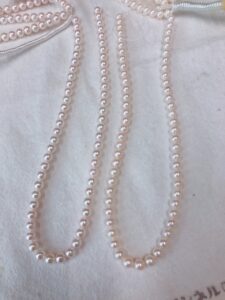
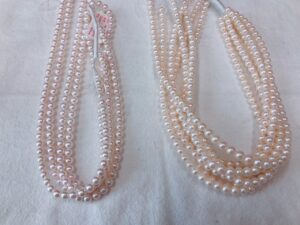
Left: Saltwater Akoya | Right: Freshwater
Look at the photo above. Can you spot the difference?
Probably not. Visually, the luster is nearly identical. This is why static photos can be misleading. We need to see them in motion.
3. The Solution: “The Rolling Test”
This is the most practical way to verify your pearls at home. All you need is a flat table and a white cloth.
Step 1: The Akoya Roll (Smooth)

Watch closely.
Because Akoya pearls have a solid round core, they roll smoothly, quickly, and in a straight line. There is absolutely no resistance.
Step 2: The Freshwater Roll (The Wobble)

Now, look at the Freshwater pearls.
Even though they appear round, they are structurally oval. Notice the movement? They wobble, undulate, and zigzag. They look almost “drunk” as they roll down the fabric.
Step 3: Rolling Side by Side

Let’s roll them side-by-side for the ultimate test. Can you spot the difference?
The bottom four strands are the Saltwater Akoya pearls.
Notice the contrast in movement
- Saltwater (Bottom): They glide effortlessly in a straight line. Smooth and consistent.
- Freshwater (Top): They wobble and bounce slightly as they roll. It’s a “bumpy” ride compared to the saltwater strands.
4. The Science Behind the Roll
If we drew a cross-section of these pearls, it would look like this:

- Akoya: Geometric Circle = Smooth Roll
- Freshwater: Irregular Oval = Wobbly Roll
It’s simple physics. The perfect sphere glides; the irregular shape stumbles.
[Summary]
To summarize, if you are unsure about your pearls, lay them on a flat surface and give them a gentle push.
| Type | Structure | Rolling Motion | Price Point |
| Akoya | Round Bead Nucleus | Smooth & Straight | High (Investment) |
| Freshwater | Solid Nacre (Tissue) | Wobbly & Bumpy | Affordable (Daily) |
While there are rare exceptions (some top-tier Freshwater pearls are incredibly round), this test works 95% of the time in the commercial market.
Knowing exactly what you are buying or selling is the first step to a smart jewelry investment.
Still not sure if your pearls are Saltwater or Freshwater?
Feel free to visit our showroom for a professional consultation. We can help you identify the quality and value of your gems.
📍 Location: 24, Donhwamun-ro 8-gil, Jongno-gu, Seoul, Republic of Korea (Store visits welcome!)
💬KakaoTalk: hibird1/ 010-5279-7103
📸 Instagram: @hibird1