A Lighthearted but Seriously Helpful
Look at Natural, Saltwater, and Freshwater Pearls
If you’ve ever looked at pearls and thought,
“Wait… why do some glow softly while others sparkle like tiny moons?”
you’re in the right place.
Pearls come in more varieties than most people realize.
And yes once you learn the differences, you’ll never look at a necklace the same way again.
Let’s take a relaxed, friendly, and slightly fun walk through the pearl universe.
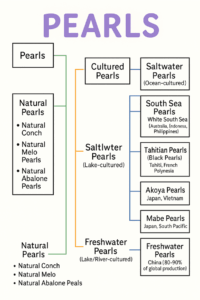
1. Natural vs. Cultured Pearls
(The pearl world’s version of nature-made vs. human-assisted)
Before we get into the fancy names, here’s the simple breakdown:
✔ Natural Pearls
Mother Nature did all the work.
No farming, no human intervention just pure luck and biology.
These pearls are rare enough to make collectors weak in the knees.
✔ Cultured Pearls
Humans give the mollusk a “nudge,”
but the pearl still forms naturally inside the shell.
These are the pearls you see in almost all modern jewelry shops.
Think of it like gardening:
Natural pearls are wildflowers; cultured pearls are homegrown roses.
2. Natural Pearls
The unicorns of the pearl world ?
These gems form completely by chance, which is why they’re so precious.
● Conch Pearls

Pretty pink or peachy pearls with a signature flame-like pattern.
They don’t have the classic pearl shine, but they glow like they’re lit from within.
● Melo Melo Pearls

Orange, warm-toned pearls found in Southeast Asia.
If a mango and a gemstone had a baby — this would be it.
● Natural Abalone Pearls

Vibrant blues, greens, and purples.
They look like tiny galaxies trapped in a shell.
Very rare, very magical.
3. Cultured Pearls
The stars of modern jewelry
These pearls are grown with the help of pearl farmers
(think: pearl parents who make sure everything goes smoothly).
They fall into two groups:
•Saltwater pearls
•Freshwater pearls
And oh, do they have personality.
4. Saltwater Pearls
Elegant, luminous, and a bit dramatic (in a good way)
Saltwater pearls are known for their sharp luster and high-end look.
✔ South Sea Pearls
The luxurious “big pearls” everyone admires.
• White South Sea

Soft, satin-like glow.
Classy in a “quiet luxury” kind of way.
• Golden South Sea

Ranging from champagne to rich 24K-gold tones.
The deeper the gold, the louder the “wow.”
• Tahitian (Black) Pearls

Not dyed naturally dark!
Colors like peacock green, deep silver, or eggplant purple.
Perfect if you’re feeling mysterious and stylish at the same time.
✔ Akoya Pearls
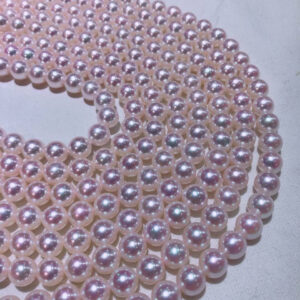
The “classic pearl necklace” pearls.
Small but mighty, Akoya pearls shine like tiny round mirrors.
Picture the pearls Audrey Hepburn would approve of that’s Akoya.
✔ Mabe Pearls

Half-round beauties with a unique glow.
They sit like domed bubbles and make perfect pendants.
✔ Cultured Abalone Pearls
They bring all the rainbow drama but in a more accessible way.
Iridescent, colorful, and wonderfully artsy.
5. Freshwater Pearls
Affordable, versatile, and bursting with charm


Freshwater pearls are the friendliest pearls around — full of variety and budget-friendly.
Fun fact:
One freshwater mollusk can grow 30–40 pearls at a time.
(Imagine being that productive.)
Why people love them:
•Tons of shapes: round, oval, baroque, rice, button
•Naturally fun colors: white, pink, lavender, peach
•Perfect for both casual outfits and trendy designs
•Amazing value for the quality you get
Modern farming techniques have made high-quality freshwater pearls so good
that they can sometimes pass for Akoya pearls at a fraction of the price.
6. What Each Pearl Feels Like When Worn
(Because jewelry isn’t just about looks it’s a vibe)
•Akoya → Polished, elegant, “I have my life together” energy
•White South Sea → Luxurious, soft-focus glow
•Golden South Sea → Bold, rich, confident
•Tahitian → Mysterious, modern, effortlessly cool
•Freshwater → Playful, youthful, everyday-cute
•Baroque → Artsy, unique, “I’m not like other pearls”
7. What Makes a Pearl Valuable?
The checklist jewelers swear by
Just like diamonds, pearls have quality factors:
✔ Luster
How bright does it shine?
✔ Surface
Smooth or blemished?
✔ Shape
Round is the rarest especially in larger sizes.
✔ Color
Some tones are incredibly hard to find.
✔ Size
Big pearls = longer growth = higher value.
✔ Origin
Different regions produce different qualities.
Even two pearls from the same farm can have dramatically different prices
depending on water conditions and mollusk health.
8. Pearls That Aren’t Pearls
Beautiful? Yes.
Real nacre-grown pearls? Nope.
These include:
•Swarovski pearls
•Majorica pearls
•Shell-core imitation pearls
•Glass or plastic beads
Gorgeous for fashion jewelry,
but completely different from natural or cultured pearls.
Final Thoughts (The Cozy Wrap-Up)
Pearls aren’t just gemstones — they’re little stories formed inside living shells.
Once you understand the differences between each type,
choosing the right pearl becomes a joyful process rather than a confusing one.
And if you ever find yourself stuck between Akoya, South Sea, or Freshwater?
Don’t worry — there’s a perfect pearl for everyone.
Sometimes your heart just knows. ❤️
If you need help choosing, comparing, or checking market prices,
I’m always here to help.
- 📍 Location: 24, Donhwamun-ro 8-gil, Jongno-gu, Seoul, Republic of Korea (Store visits welcome!)
- 💬KakaoTalk: hibird1/ 010-5279-7103
- 📸 Instagram: @hibird1